The Book of Broken Promises:
$400 Billion Broadband Scandal & Free the Net
Available as a Paperback, Kindle or PDF
With the FCC’s new Open Internet/Net Neutrality decision and the onslaught of court cases that will continue for years, The Book of Broken Promises emerges to expose the sad truth about communications services in America and to answer a fundamental question — How did we get into this mess and what can we do to fix it today?
The third book in a trilogy spanning 18 years, Bruce Kushnick, author, senior telecom analyst and industry insider, lays out, in all of the gory details, how America paid over $400 billion to be the first fully fiber optic-based nation yet ended up 27th in the world for high-speed Internet (40th in upload speeds). But, this is only one part of the story.
With over four million people filing with the FCC to ‘Free the Net’, one thing is abundantly clear — customers know something is terribly wrong. Every time you pay your bills you notice that the price of your services keeps going up, you don’t have a serious choice for Internet (ISP), broadband or cable service, much less competitors fighting for your business, or maybe you can’t even get very fast broadband service. Worse, over the last few years, America’s ISPs and cable companies have been rated “the most hated companies in America”.
While Net Neutrality concerns (detailed in Broken Promises) are important, the actions are only a first step and will most likely be tied up in court for the next few years. More importantly, it does not resolve most of the customer issues and there is nothing else on the horizon that will fix what’s broken.
Broken Promises documents the massive overcharging and failure to properly upgrade the networks, the deceptive billing practices, the harms caused from a lack of competition, the gaming and manipulating of the regulatory system, from the states to the FCC, and exposes the companies’ primary strategy — How much can we get away with? There has been little, if any, regard for the customers they serve.
But Don’t Take Our Word for Any of It. The Book of Broken Promises:
- Supplies new, never seen before data, including telco financials, and analysis that offers an alternative path to solve Net Neutrality and restructure communications.
- Broadband Scandal — Documents, in detail, the broken promises and failure to upgrade the networks even though customers paid over $400 billion in excess fees and phone charges for network upgrades since the 1990’s.
- Your State? — Supplies details of how AT&T, Verizon and Centurylink went state-to-state to change the laws to charge customers for a fiber optic future that never showed up.
- School Wiring Overcharging — Though it varies by state, we were all charged about 9 times by the phone & cable companies to wire America’s schools & libraries.
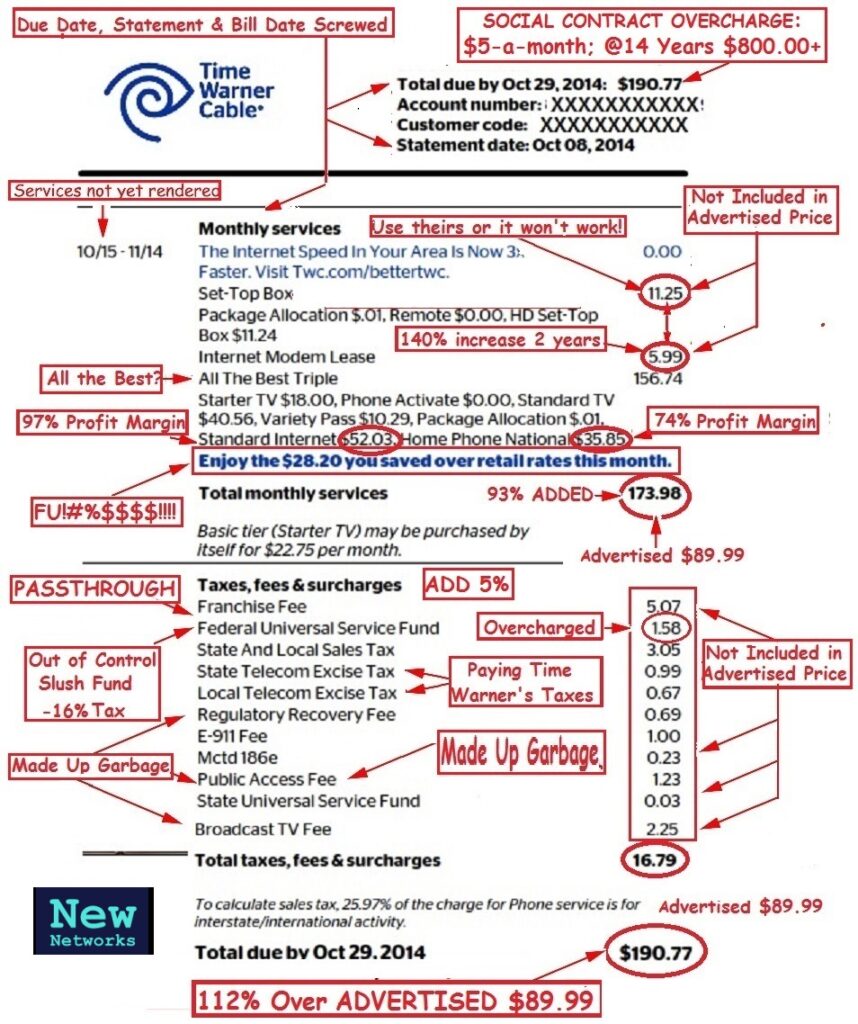
- Social Contract? Time Warner Cable & Comcast’s so-called “Social Contract” deal with the FCC was a plan to raise your cable rates.
- Mergers Harmed America — Broken Promises tells the complete history of the mergers and broken promises that created AT&T, Verizon and Centurylink – and why we need to stop the current proposed mergers.
- The AT&T-Verizon “IP Transition” Con — Disguised as a technology improvement, the plan is designed to remove all regulations and oversight, not “free the net”.
- Fake Consumer Groups and Skunkworks — Details how the phone & cable companies keep control with fake consumer groups (astroturf), paid off politicians, corporate-funded stink tanks, co-opted non-profit organizations, massive skunkworks networks, and diss-information campaigns, including the ALEC/Corporate-sponsored deregulation bills from hell, and the anti-competitive barrier to entry for competing community/municipal infrastructure build outs, etc.
- Delivers Encyclopedic Coverage, with hundreds of links to reports and articles and covers everything, from the ‘made up’ charges on your bills, or the taxes applied, like the Universal Service Fund, (USF), to the municipalities rolling out broadband or what ever happened to the National Broadband Plan.
- Buzzwords Explained — Don’t worry; all of this jargon will be in plain English.
- Scandals Galore — Verizon claims Net Neutrality is bad because “Title II” harms investment, yet Verizon’s entire fiber networks are all based on “Title II”. AT&T’s U-Verse is a ‘copper-to-the-home’ service with fiber somewhere within ½ mile. Read about merger conditions written on toilet paper, the massive cross-subsidies charged to customers to fund other businesses going unchecked, or that whole state legislatures have been captured by the phone & cable company ‘trust’. You will be shocked at what you don’t know or were never told, and how much it has cost you, your family, your business, your city and America’s economy.
Solution: Take Action: It is time America takes a new path that includes audits, investigations and more importantly opens the networks to direct competition and finally separates the companies that took control of essential infrastructure, from the wires. Broken Promises provides the documentation and a proactive plan, a roadmap on how states and cities can take advantage and leverage the companies’ failed broadband commitments and the companies’ questionable financial and business practices. The goal — Move America to an open, very fast, fiber optic-based, yet affordable, broadband, Internet, and cable service for everyone — since everyone paid for it over and over and over.
This is the third book of a trilogy that started in 1998: